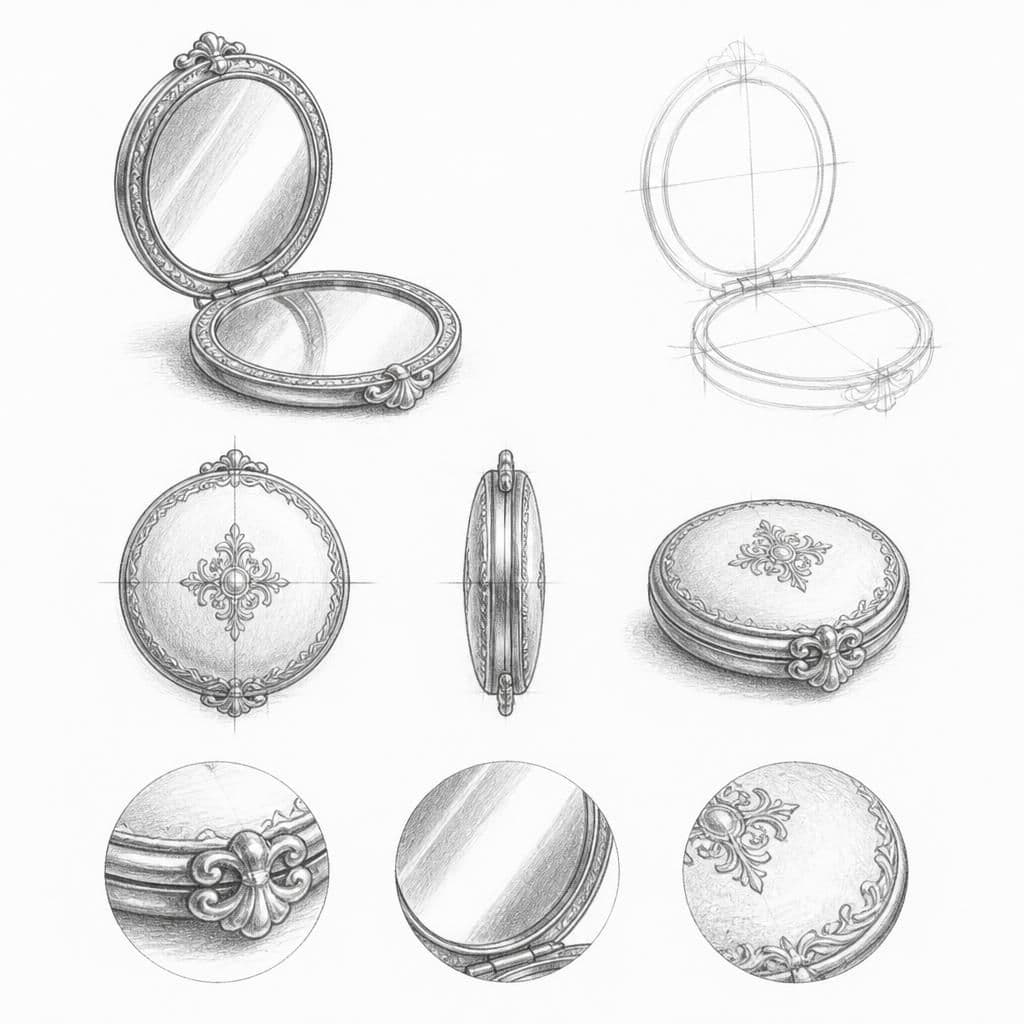
What you'll learn
Drawing a pocket mirror requires attention to reflections, light, and surface texture. These aspects challenge your ability to capture subtle nuances and shapes that change with perspective and lighting.
What you'll need
Step-by-step: how to draw pocket mirror
Begin by observing the overall shape and proportions of the pocket mirror, sketching a light outline.
Focus on the edges and any decorative elements, noting their lines and relationships.
Identify where the light highlights the mirror's surface and lightly shade to indicate reflections.
Capture any distinct textures or patterns on the mirror's surface or frame.
Finalize by refining details, ensuring reflections and light effects are accurately depicted.
Before you start: what to look at
Notice the mirror's surface curve, where reflections appear and distort. Pay attention to any decorative elements' edges and how light interacts with them. Observe how light and shadow fluctuate across the frame and surface.
Pro tips for drawing pocket mirror
Common mistakes drawing pocket mirror
Self-evaluation checklist
Check if the reflections and light effects are convincing, ensuring the textures are unique to the pocket mirror. The sketch should show the mirror's real proportions and subtle details.
Frequently asked questions
How do I accurately represent reflections in the mirror?
Focus on the shapes and distortions you see in the mirror. Simplify the reflections into basic shapes and gradually add detail as needed.
How can I capture the texture of a decorative frame?
Pay attention to repeating patterns and use light shading to indicate texture. Cross-hatching can also help create depth.
What if the mirror reflects too many things?
Choose one or two key elements to focus on, capturing the essence of the reflection without overcrowding your drawing.
More drawing lessons
Get a new drawing lesson delivered to your inbox every morning, free.
Subscribe to Draw Daily →