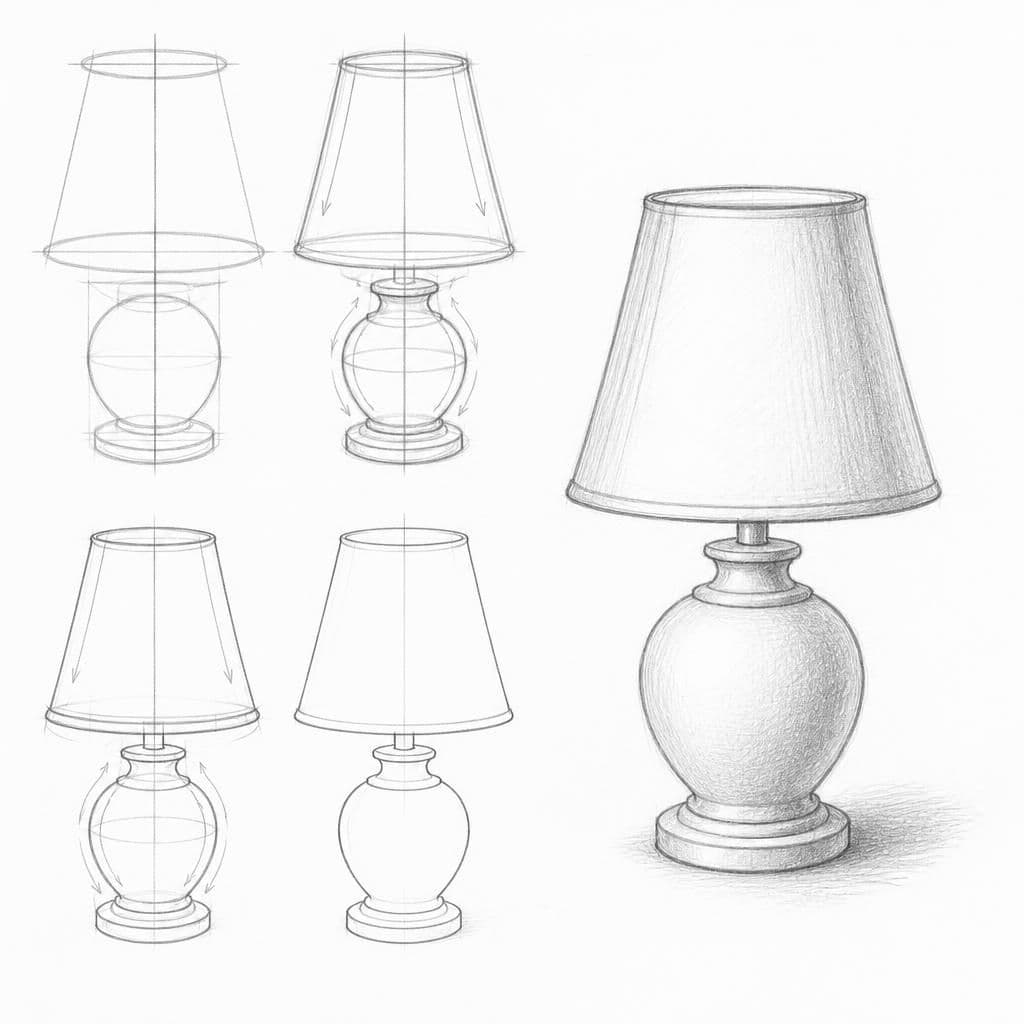
What you'll learn
Drawing a table lamp helps you focus on capturing the subtle curves and straight lines of an everyday object. The intermediate level involves understanding the interplay of light and shadow, as well as the precise proportions that make the lamp recognizable.
What you'll need
Step-by-step: how to draw table lamp
Position the table lamp at a slight angle that shows its form well.
Spend 3 minutes closely observing the shape and noting the way light falls across it.
Use a light contour line to map out the basic shape and proportions without lifting your pencil.
Pay attention to details like the lamp's switch, base, and shade's curves, adding those elements next.
Refine your lines, ensuring that the proportions and angles capture the lamp accurately.
Before you start: what to look at
Look at the edges where the lamp's shade meets the air; notice how light defines this boundary. Observe the curve of the lamp's base and how it contrasts with the straight stem. Pay attention to where the light lands on the shade and creates subtle gradations in tone.
Pro tips for drawing table lamp
Common mistakes drawing table lamp
Self-evaluation checklist
Check if the proportions and angles of your drawing match the perspective of the actual lamp. Ensure that the contour lines capture the essence of the lamp's design and structure.
Frequently asked questions
How do I accurately capture the shape of the lamp's shade?
Focus on the ellipse at the top and bottom of the shade. Ensure they align with your perspective view. Note how they slightly flatten at the sides and become more rounded toward the front and back.
What is the best way to handle metallic surfaces on the lamp?
Metallic surfaces have distinct highlights and reflections. Use a range of pencil pressures to create high contrast between the bright highlights and dark shadows. Capture reflections by observing how the lamp's environment is mirrored on its surface.
How do I draw the lamp's power cord without it looking awkward?
Observe the natural curve and flow of the cord as it trails off the table. Use light, fluid lines to sketch its path. Ensure the cord's thickness remains consistent and pay attention to how it overlaps other elements in your composition.
More drawing lessons
Get a new drawing lesson delivered to your inbox every morning, free.
Subscribe to Draw Daily →