Your drawing coach,
one exercise a morning.
One exercise each morning, ten to thirty minutes, on paper. Draw it, and with Pro, photograph it and get it graded on what you put down: what landed, and the one thing to push tomorrow. Your streak keeps the score.
Confirm your email, set up your practice, then explore Pro with a 7-day free trial.



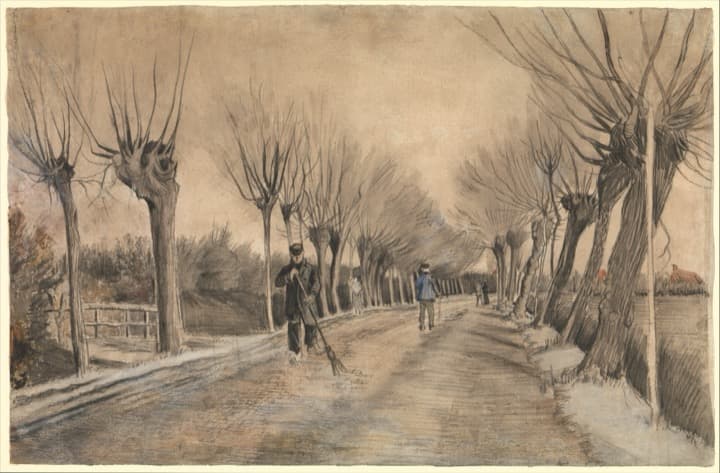
“But only on condition of working hard: not a day without a line, as Gavarni used to say.”
Vincent van Gogh, letter to his brother Theo, Brussels, January 1881
Skill comes from turning up, not from long sessions.
Half an hour once a week teaches you less than ten minutes a day. The hand needs repetition close together, and the gap between sessions is where progress leaks away.
Today's Drawing Exercise
Subject
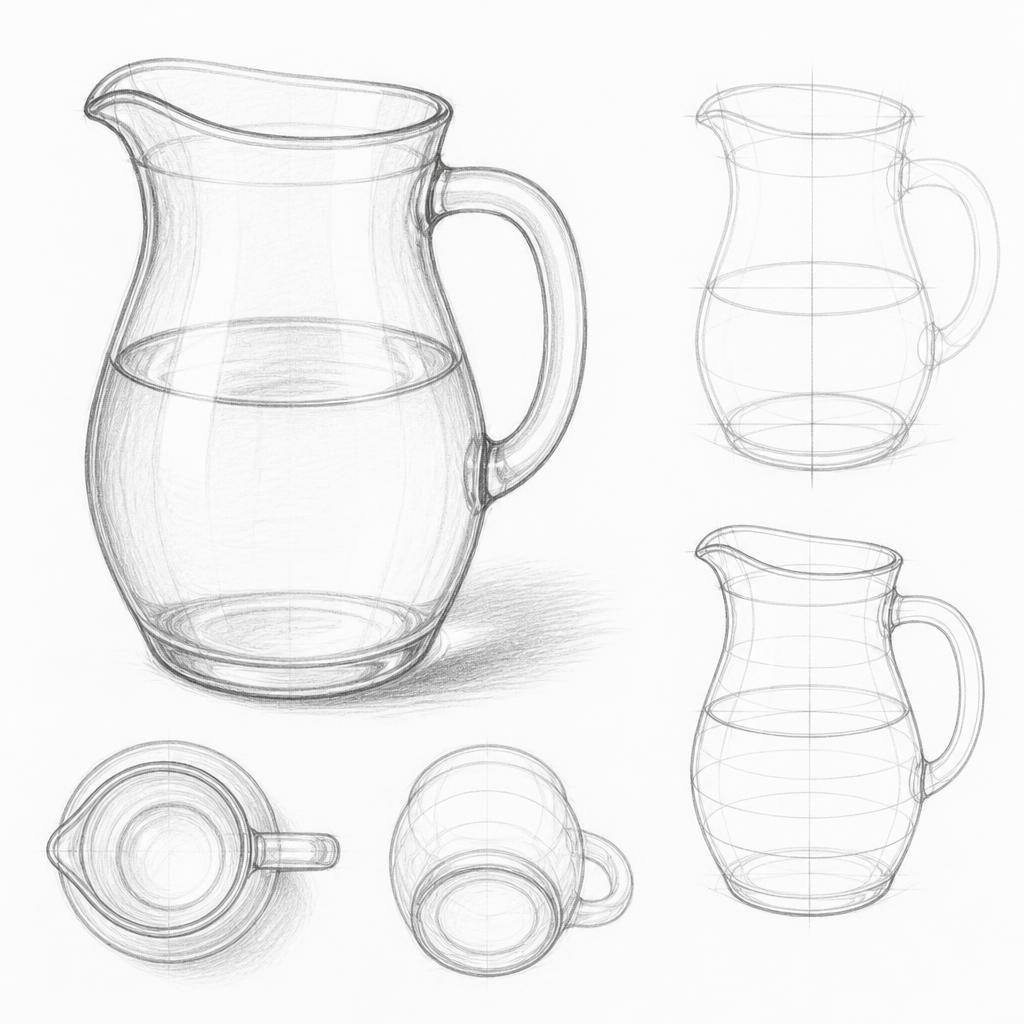
Water Pitcher
What you'll practice
A water pitcher presents a compelling challenge with its curvilinear form and distinct spout. Capturing its proportion and volume will hone your ability to represent rounded surfaces and asymmetrical shapes.
Step-by-step guide
- 1Start with a light sketch of a vertical axis to help place the pitcher symmetrically.
- 2Outline the general shape of the pitcher starting from the base, defining the oval or circular bottom.
- 3Draw the body of the pitcher, paying attention to the curvature as it tapers towards the neck.
- 4Sketch the spout, ensuring it aligns properly with the body, and take note of how it protrudes forward.
- 5Add the handle, making sure to capture its attachment points and curvature relative to the body.
- 6Refine the drawing by emphasizing contours, adjusting proportions, and adding any details such as decorative elements or seams.
Pro tips
- —Use your pencil to measure proportions and compare different parts of the pitcher.
- —Observe how light interacts with the curved surfaces to convey volume.
- —Keep your lines light at first, focusing on capturing the correct form before adding details.
- —Consider the negative space around the handle and spout; it can help in checking the overall proportions.
Self-evaluation
Check if the pitcher looks balanced and if its proportions are consistent. Ensure the body reads as a three-dimensional form, not a flat shape.
Draw it. Then find out how it went.
Practising alone has one problem. Nobody tells you what you got wrong, so you practise it again tomorrow. Finish an exercise, photograph your sketch, and get notes back on it within a minute.
Judged against that exercise and the time it was meant to take, so a ten minute warm up is read as a ten minute warm up and not as a finished piece.
Try 7 days free →Part of Draw Daily Pro. The trial needs a card, and you can cancel before day 7.
A sketch of a fruit bowl with apples and a sliced citrus fruit.
What is working
- ✓The outlines of the fruits are clear and well defined.
- ✓The shading on the apples shows a good attempt at creating depth and form.
What to fix
- →Increase the contrast between light and shadow to enhance the three dimensional effect.
- →Smooth out the shading transitions to avoid harsh lines between light and dark areas.
It notices whether you turned up.
Mark the exercise done and your streak goes up by a day. Miss a day and it starts again, which is the point. Badges mark the days worth marking, from the first drawing to a hundred days in a row.
With Pro, every graded drawing adds a point to your chart, so you can look back over the weeks and see the high scores and the low ones.
Create a free account →Streaks and most badges are free with an account. The chart comes with Pro.
Each score is for that day's exercise, so a harder one can bring it down.