What you'll learn
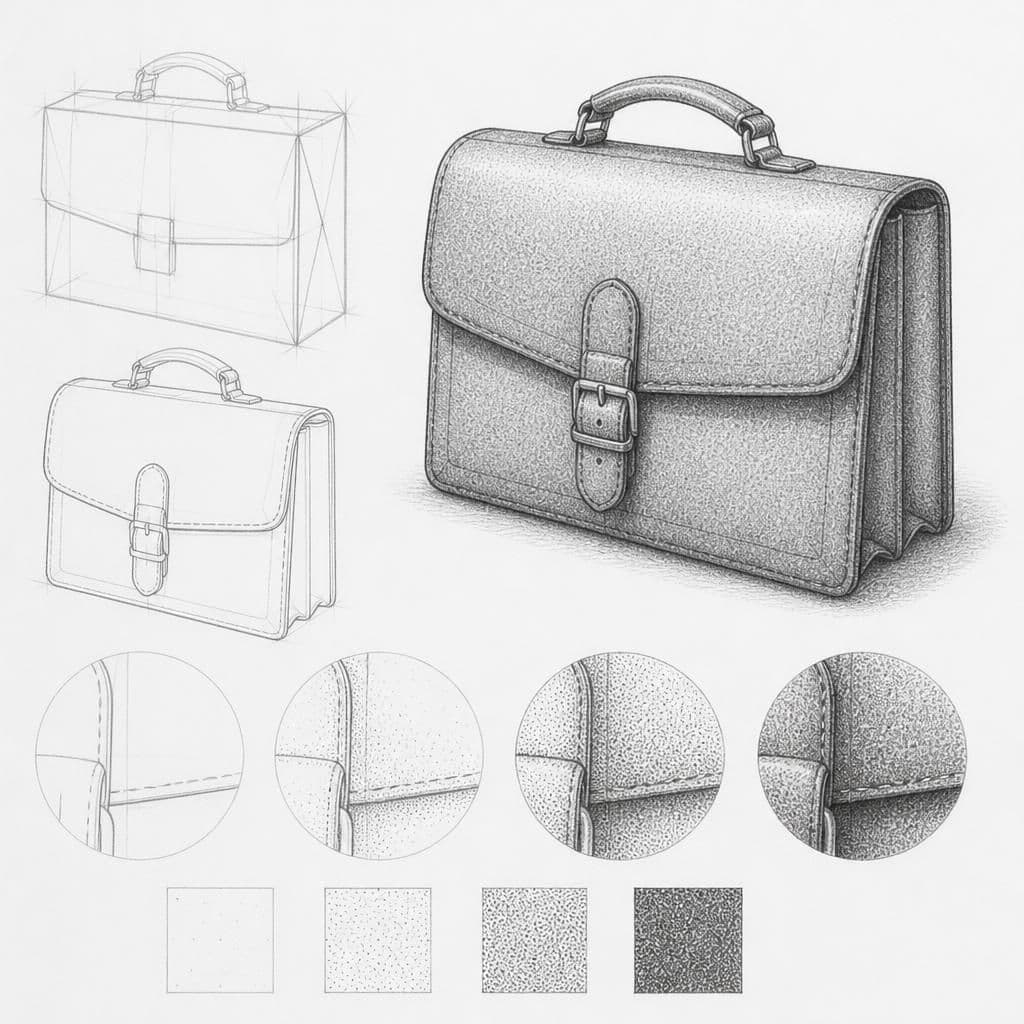
A leather briefcase provides a complex texture to capture, with its smooth and grainy variations. It challenges the artist to interpret subtle lighting changes and the intricate surface details of leather.
What you'll need
Step-by-step: how to draw leather briefcase
Quickly sketch the outline of the briefcase, focusing on proportions and key elements like handles and buckles.
Identify the areas where the light creates highlights and where shadows deepen on the leather surface.
Use stippling to create the effect of the leather texture, varying the density of dots to convey different levels of shadow and highlight.
Add details to the metal parts and the stitching to enhance the contrast with the leather texture.
Before you start: what to look at
Before you start drawing, observe the subtle curves where the handle meets the main body, and notice how light reflects differently on the smooth versus textured areas. Pay attention to the edges of the buckles and how they catch the light, as well as the stitching that runs along the briefcase's seams.
Pro tips for drawing leather briefcase
Common mistakes drawing leather briefcase
Self-evaluation checklist
Check if the sketch convincingly represents the leather's texture, with believable light reflections and shadow depths. The different parts should stand out through contrasting texture techniques.
Frequently asked questions
How do I capture the subtle variations in the leather texture?
Use stippling to vary the density of your dots. More dots create shadowed areas, while fewer dots suggest highlights. Focus on the transitions between these areas to capture the nuances of the texture.
What is the best way to draw the briefcase handle realistically?
Pay close attention to the curvature of the handle and how it attaches to the briefcase. Observe the shadows under the handle and how light affects its surface. These details add realism to your drawing.
How should I approach drawing the stitching on the briefcase?
Observe the pattern and depth of the stitching carefully. Use fine lines to depict the thread and its shadow. Consistent spacing and alignment are crucial to convey the handcrafted detail accurately.
More drawing lessons
Get a new drawing lesson delivered to your inbox every morning, free.
Subscribe to Draw Daily →