What you'll learn
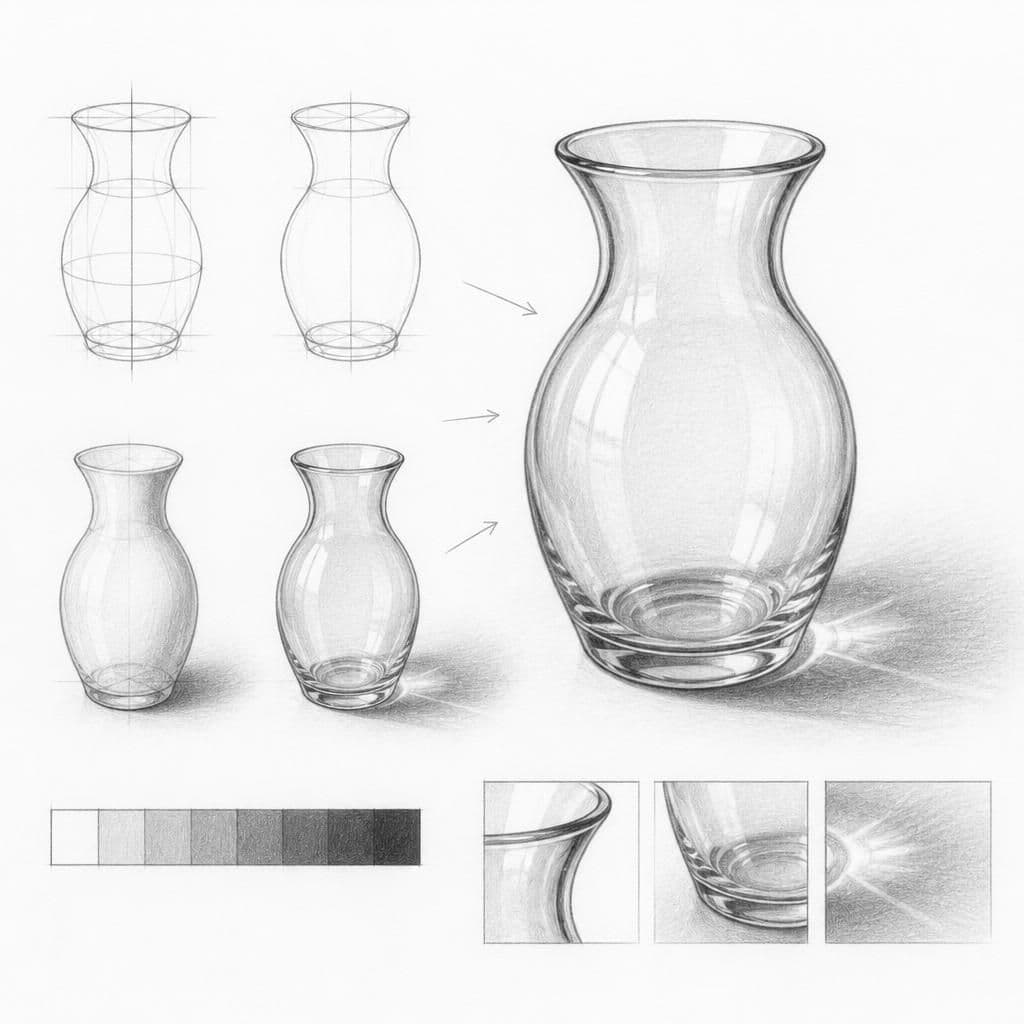
A glass vase offers intermediate artists a chance to explore transparency, light direction, and subtle value shifts. Practicing with this object enhances your ability to depict reflections and the interplay between light and shadow.
What you'll need
Step-by-step: how to draw glass vase
Position the vase so that a clear light source creates distinct highlights and shadows.
Begin with a light sketch to outline the general shape of the vase.
Focus on identifying the brightest highlights and gently mark them.
Use hatching or cross-hatching to build up the mid-tones and shadows, paying attention to the curves of the vase.
Finalize the drawing by refining the darker areas and blending slightly to indicate the glass's smooth texture.
Before you start: what to look at
Observe how the light source creates specific highlights along the rim and body of the vase. Notice where the light lands on the curved surfaces and how it diffuses through the glass, revealing subtle shifts in value. Pay attention to the edges where the glass distorts or magnifies the background behind it.
Pro tips for drawing glass vase
Common mistakes drawing glass vase
Self-evaluation checklist
Evaluate the sketch by checking if the glass appears transparent and if the light direction is clear. Ensure that the highlights and shadows are distinct yet harmonious, reflecting the glass's texture.
Frequently asked questions
How do I create the illusion of transparency in the glass vase?
Focus on accurately capturing the highlights and the areas where the light passes through, as well as the subtle shifts in value. Use lighter pressure to create these areas and ensure they blend smoothly with the surrounding tones.
What is the best way to depict the curved surfaces of the vase?
Use curved hatching lines that follow the contour of the vase. This helps to convey the three-dimensional form and the direction of the curves. Observe how the reflections and shadows alter along these curves.
How can I accurately draw the reflections on the vase?
Begin by observing the shapes and patterns of the reflections. Then, lightly sketch these areas with precision, keeping in mind that reflections often follow the contours of the vase. Layer the graphite gradually to achieve the correct intensity.
More drawing lessons
Get a new drawing lesson delivered to your inbox every morning, free.
Subscribe to Draw Daily →