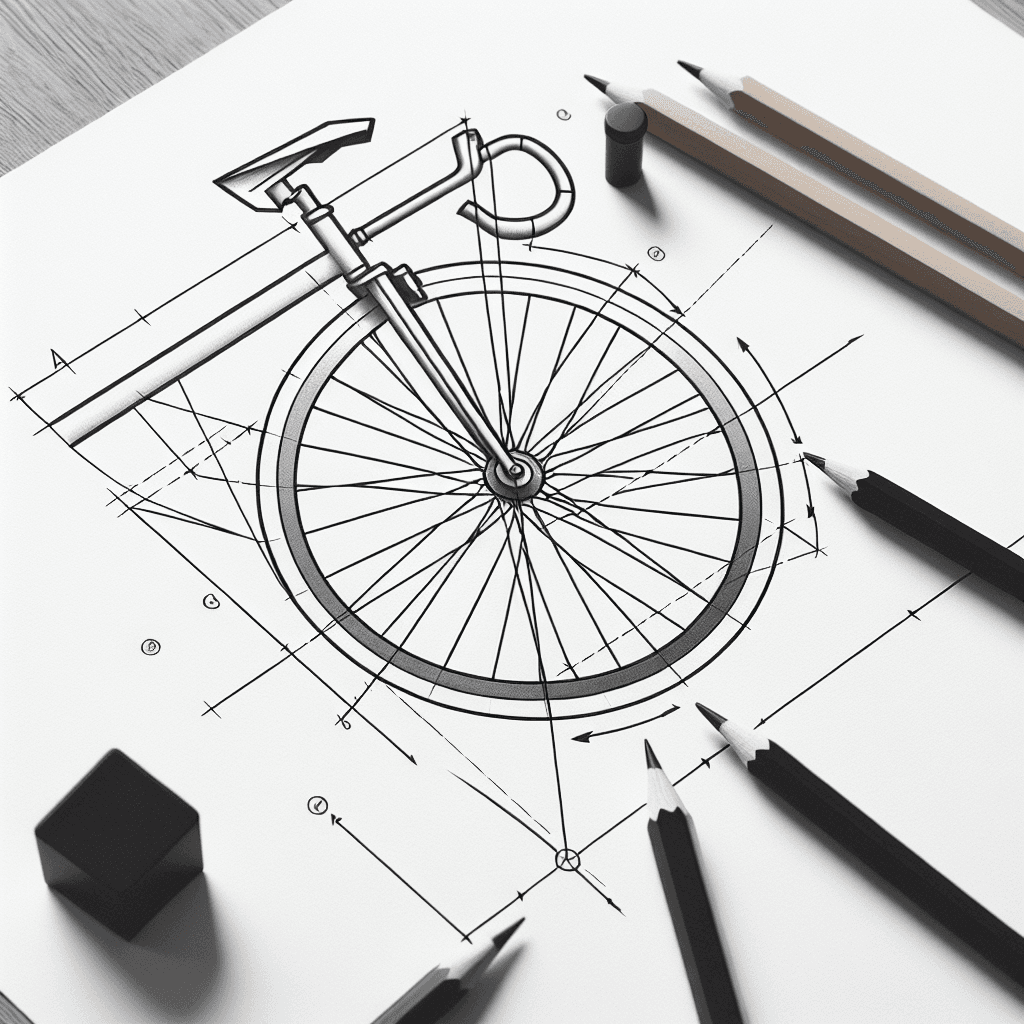
What you'll learn
A bicycle wheel helps you practice perspective, as it involves capturing circular shapes with depth and proportion. This exercise will enhance your ability to see and represent objects in three-dimensional space.
What you'll need
Step-by-step: how to draw bicycle wheel
Begin by lightly sketching a horizontal ellipse for the wheel.
Mark the hub's center within the ellipse to establish a reference point.
Draw straight, radial lines from the hub outward to the rim to represent the spokes, adjusting for perspective.
Add depth by sketching the tire around the ellipse with an inner and outer contour line.
Refine your lines, adding details to the hub, rim, and spokes, and shade to indicate light and shadow.
Before you start: what to look at
Notice the elliptical shape of the wheel when viewed from an angle, along with how the spokes converge at the hub. Look at how light affects the tire's surface, often creating a highlight along the top edge and a shadow underneath.
Pro tips for drawing bicycle wheel
Common mistakes drawing bicycle wheel
Self-evaluation checklist
Check if the wheel appears circular yet three-dimensional, with correctly aligned and symmetrical spokes. Ensure the shading suggests its cylindrical form and depth.
Frequently asked questions
How do I maintain consistent spacing between the spokes?
Start by lightly sketching radial lines from the hub outward, ensuring they are evenly spaced. Use a ruler or straightedge to maintain consistency, adjusting for the perspective as it changes along the ellipse.
What should I focus on when shading the wheel?
Pay attention to the light source. Add highlights on the upper curve of the tire and shadows underneath. Shade the spokes delicately to suggest their cylindrical nature and the reflective properties of metal.
How can I ensure the wheel looks proportionate with perspective?
Begin by correctly establishing the major and minor axes of the ellipse. Use these axes to guide the placement of the hub and spokes, ensuring they converge properly. Constantly compare with a reference or real wheel to adjust proportions as needed.
More drawing lessons
Get a new drawing lesson delivered to your inbox every morning, free.
Subscribe to Draw Daily →