What you'll learn
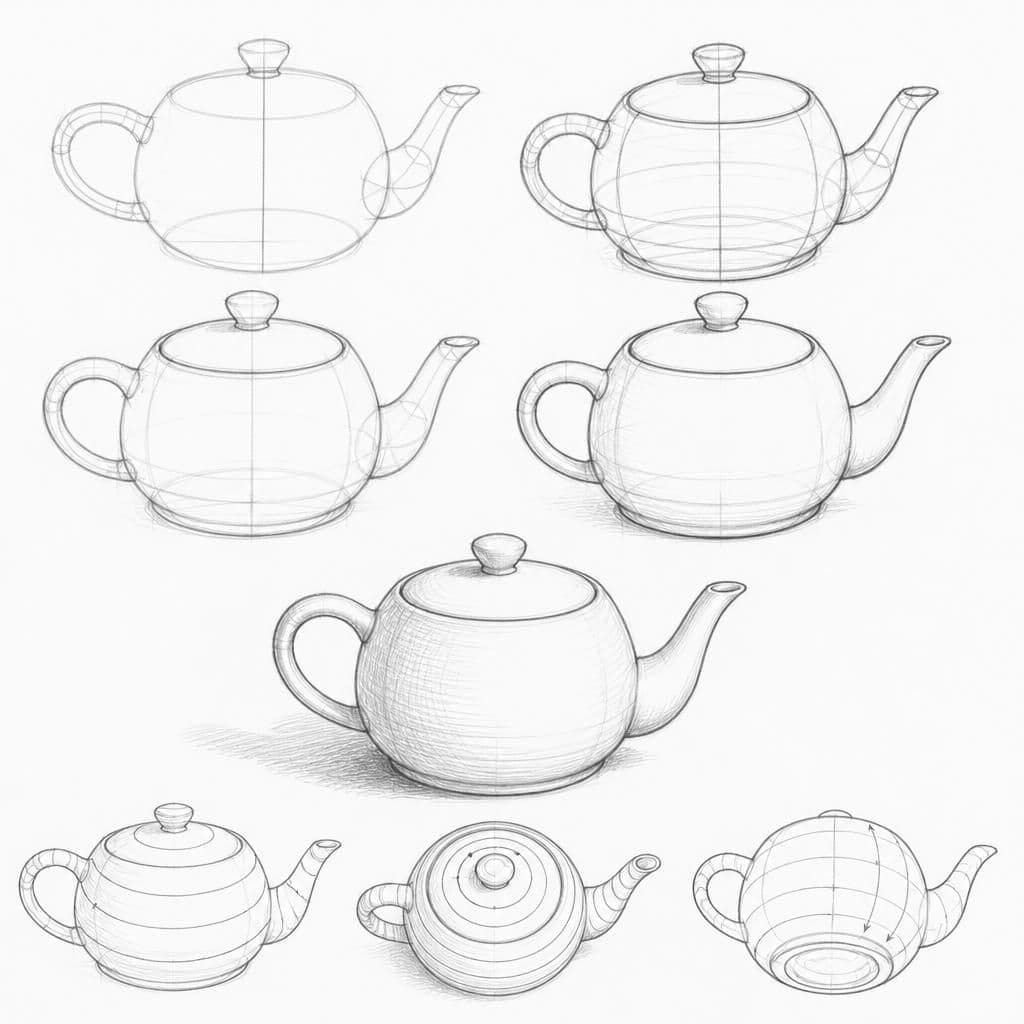
A teapot offers a variety of curved surfaces and distinct parts such as the spout, handle, and lid. Drawing these elements assists beginners in understanding how to measure relative sizes and capture the three-dimensional volume of objects.
What you'll need
Step-by-step: how to draw teapot
Start by sketching the main body of the teapot. Focus on capturing its basic shape and size in relation to the whole object.
Draw the handle, paying attention to its proportional size compared to the main body.
Add the spout, ensuring it aligns correctly with the body and is proportionate.
Sketch the lid. Observe how it fits on top of the teapot and adjust for any perspective effects.
Refine the contours and add gentle shading to suggest volume without overworking the drawing.
Before you start: what to look at
Examine the teapot's silhouette to understand its primary shape and how different parts connect. Notice how the widest part of the body relates to the overall height. Observe where light hits the surface to identify the areas that are naturally emphasized by highlights.
Pro tips for drawing teapot
Common mistakes drawing teapot
Self-evaluation checklist
Compare the proportions of the spout, handle, and lid to the teapot's body. Ensure the volume is conveyed through consistent line weight and accurate representation of the object's curves.
Frequently asked questions
How do I ensure the spout looks like it's part of the teapot?
Align the spout with the body by observing its base attachment point. Draw it as an extension of the teapot's curve, maintaining consistent perspective and direction.
What should I focus on to capture the teapot's material?
Pay attention to how light reflects off the surface. For a shiny teapot, emphasize highlights with lighter shading. For a matte finish, use more uniform tones to convey texture.
How do I deal with an unusual teapot shape?
Break down the shape into basic geometric forms. Identify the core cylinder or sphere before adding unique elements. This helps maintain proper proportion and volume throughout.
More drawing lessons
Get a new drawing lesson delivered to your inbox every morning, free.
Subscribe to Draw Daily →