What you'll learn
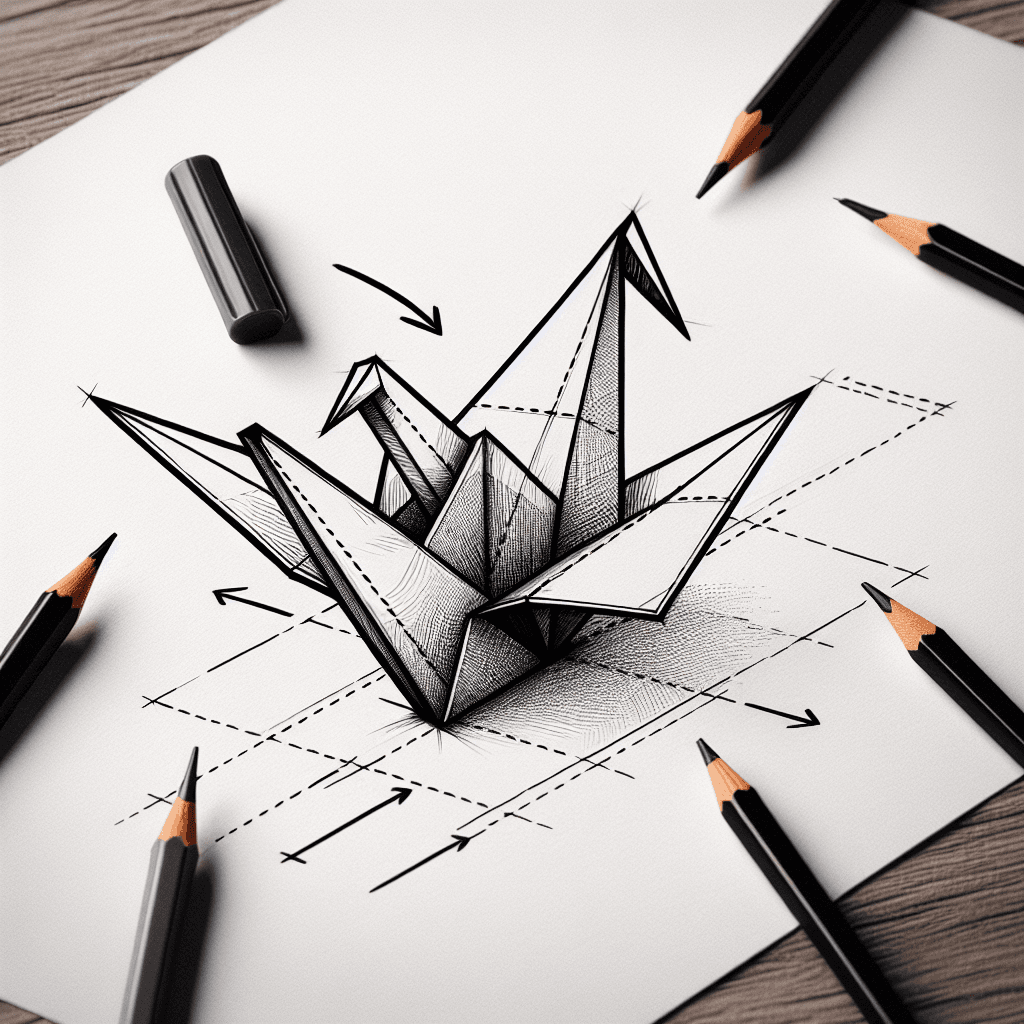
Drawing a folded paper crane helps you practice how light interacts with surfaces to create shadows and highlights, enhancing your understanding of form and depth.
What you'll need
Step-by-step: how to draw folded paper crane
Start by sketching the basic outline of the paper crane, focusing on its geometric shapes.
Identify the light source and lightly draw guidelines for the shadows.
Add details to the crane, such as the creases and folds, to emphasize its three-dimensional nature.
Begin shading the areas opposite to the light source, gradually building up darker tones in the deepest shadows.
Refine your shading to create smooth transitions between light and dark, enhancing the crane's form and making it look realistic.
Before you start: what to look at
Look at the top edges of the crane's wings to understand how they create a sharp profile against the light. Notice the subtle curve of the crane's neck, which adds elegance to its form. Pay attention to where light lands on the flat surfaces, especially on the wings and the body, to determine where the highlights should be placed.
Pro tips for drawing folded paper crane
Common mistakes drawing folded paper crane
Self-evaluation checklist
Check if the shadows and highlights realistically reflect the light source and if the folds are clearly defined and add depth.
Frequently asked questions
How do I figure out the correct proportions for the crane?
Start by observing the relationship between the body and the wings. The wings should be roughly twice the length of the body, and the neck should be proportionate to the body without being too long or too short.
What's the best way to draw the small, intricate folds?
Begin with light, loose lines to map out the folds. Then, gradually define these lines with more precision as you become confident in their placement. Use shading to emphasize depth at the creases.
How can I accurately depict the material of the paper?
Focus on capturing the texture by using varied pencil pressure. Light pressure for smooth areas and more pressure for the folds and edges. Observe how light reflects off the paper's surface to add subtle details.
More drawing lessons
Get a new drawing lesson delivered to your inbox every morning, free.
Subscribe to Draw Daily →